
Getting the message across through art
Jan Woolf Blog
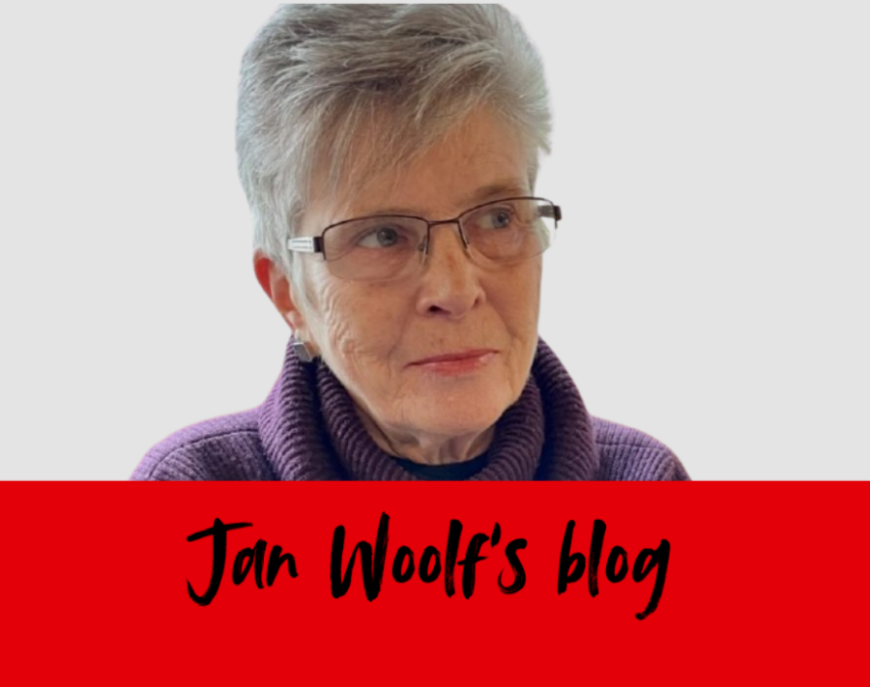
Labour CND has known JAN WOOLF since war on Iraq of 1991, when she worked with us and others as part of the Committee to Stop War in the Gulf. She has been involved with the anti-war movement most of her adult life and much of Jan’s activism has been around the arts – exhibitions and events like the shows, exhibitions, and fund-raisers she organised and curated for us in 1990-91. Nowadays she also writes short stories and plays, and has just completed a soon-to-be-launched novel.
There are ways of saying political things through art, if the art is good and not didactic or ‘messagy.’ This is the challenge for artists, whatever the form. My next play ‘Over my Dead Body’ attempts to deal with sectarian politics still being played out in a retirement home, based on the now closed Mary Fielding Guild. It will have its first rehearsed reading Upstairs at the Gatehouse, Highgate, next February. Date TBA. I’m sharing with you a monologue from this work in progress.
Setting – The sitting room of the Equity Release Retirement Home where a certain left intelligentsia like to live. Outside it is very hot – approaching 40C. Fascism is on the streets and war in Europe is brewing. We are on the eve of a general election.
Towards the end of the first act, after the usual afternoon political argument. Phil, a retired comedian with anarchist politics, accuses Jesse – a renowned peace campaigner – of being a ‘tetchy old peace-nik.’ ‘Shut up’ she reposts, then breaks the fourth wall to address the audience.
JESSE – When my sadness comes, I give it a name. Today it’s Violet – shrugs – I don’t know any Violets, and I apologise if there are any in tonight. (Pause) – There was a dinner lady called Violet at school. She would hurl up the hatch at dinner time, and we’d line up for shepherd’s pie – or whatever they served in 1962. (Pause) – 1962 – the Cuban Missile Crisis. Whoever (calculates on her fingers) over 64, could forget that? (Walks about a bit) You may find (thumbing back indicating Phil) many a tetchy peace-nik was formed this way. And of course, after the trauma – I was 12 – I’ve spent my life trying to heal that wound, in myself and the world.
Violet (places hand on her chest, deep breath)) is frisky today – don’t know what provoked her. Probably that bloody computer. You’re going along nicely with your emails, and then press the wrong button. (Pause) Pressing the button! That’s what we were so terrified off. Would the Russians do it? The Americans? I had a dream when I was 12, of holding a world in my hand. A whole world in my little 12-year-old hand. It lodged inside me like a moon, rising at times of tension. I was afraid of watching the news – in case – in case. But I had to know. (Pause) – I had to know. I couldn’t understand the politics then – what was defence, what was attack. What was communism, what was capitalism. Who was good, who bad.
My feelings were neither contained nor explained. My parents had no idea and could neither comfort nor explain. The headmaster told a school assembly – (gathers herself ) ‘The older ones among you will know of the grave danger we are in. God bless you all.’ And at home Mum telling us we would have to hide in the cupboard under the stairs if the bomb dropped, but that Smokey couldn’t come in.’ Our dog would perish.
I joined CND at art school. Regional stuff at first, sit ins. Marches to Greenham Common in the ’80s. Then as a teacher, listening out for fear in the kids, but the world was never on that same brink, and they drew little mushroom clouds for an exhibition ‘Kids for Peace’ that was shown in the local library. Then the fractious committees, the pro-Soviet, the anti-Soviet, the entryism, the Trots, the Tanks. The rows and the hollering. The only ones that didn’t were the Quakers, who would sit in silence.
Back to Violet. Yes, she’s blooming in my heart today – feeling like something too big for my body. Thanks, Phil, for – er triggering – but you also triggered my memories of sitting with the Rothkos – the beautiful calming Rothko paintings in the Tate. I love that man and his gifts to us. I love it that he turned them away from the corporate warrior set to settle with Turner, his brother in art. I used to sit there for hours, communing with them both, calming my insides – the lay of the land, and then swimming in Rothko. Knowing of his love for Turner spinning his gold. Just sitting there in the wash of his wonderful gift – (sighs) – well, he couldn’t save himself, we know, but he could save me – and I thought that spinning the base metal of fear into gold, I might save the world. We all think we can save the world. A burning world – but if we’re burning inside, we won’t want to. (hand to chest again)
Bugger off Violet. (turns to leave) Now I’m going up to my room to make a picture. Always makes me feel better. (Leaves)
Photo: Margot Elke Schiemann